
Why Did the Lender Only Count Half My Deposits?
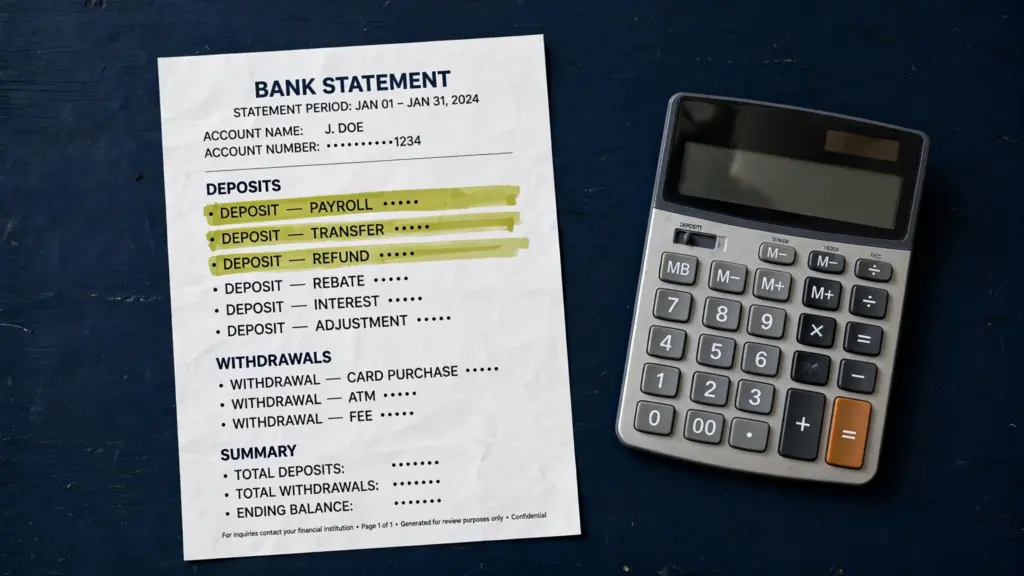
Quick answer: Because of the expense factor. On a bank statement loan, the lender averages your business deposits, then assumes a percentage of that money went right back out as business expenses — 50% is the standard assumption — and counts only what’s left as your income. If your business actually runs leaner than 50%, a letter from your CPA documenting your real expenses can replace the assumption, and the difference is routinely tens of thousands of dollars a year in qualifying income.
By Dat Nguyen | Dat Loans — Mortgage Advisor, Everyday Lending Group, NMLS #1379110 · Last updated: November 2026
The file I see every week
The conversation starts the same way a few times a month. A self-employed borrower sits down — sometimes relieved, sometimes annoyed — and says some version of this:
“I deposit eighteen thousand a month. The lender said my income is nine. What happened to the other half?”
What happened is the expense factor. Nobody explained it before the denial, so let me explain it the way I explain it at my own desk, with a real file shape.
Maria runs a salon in Garden Grove. Her business deposits average $18,400 a month over 24 months of bank statements. Her tax return, after her CPA’s work, shows $61,000 a year. Here’s what a bank statement lender does with those deposits:
| Expense factor applied | Income counted per month | Income counted per year |
|---|---|---|
| 50% (the standard assumption) | $9,200 | $110,400 |
| 30% (documented by her CPA) | $12,880 | $154,560 |
Same woman. Same salon. Same deposits. The only thing that changed is whether the lender assumed her expenses or read them.
Why the factor exists at all
Deposits are revenue. They are not profit.
If your business takes in $18,400 a month, some of that money buys product, pays rent on the chair or the truck, covers insurance, fuel, software, and help. A lender who counted gross deposits as income would be pretending your business runs at a 100% margin. No business does. So the lender applies an expense factor — an estimate of the share of deposits that are really costs — and qualifies you on the remainder.
That’s the logic, and honestly, the logic is fine. The problem is the default. Fifty percent is a blunt industry assumption built for a generic business. It is not a measurement of your business. A salon, a dispatch operation, and a solo consultant do not run at the same margin, but the standard factor treats them like they do — unless somebody documents otherwise.
The letter that changes the number
If your real expenses run below 50%, a CPA, enrolled agent, or tax preparer can write a letter stating your business’s actual expense ratio. That’s the whole move. Maria’s CPA documented a 30% expense factor, the lender counted 70% of her deposits instead of 50%, and her qualifying income went from $110,400 to $154,560 — $44,160 a year — without one dollar of her actual earnings changing.
Two honest limits on that letter:
- It has to be true. The letter documents your real ratio; it doesn’t invent one. Underwriters cross-check it against your statements and your type of business. A letter claiming a trucking company runs at 10% expenses gets the file killed, not approved.
- It has to come from a professional. Your own spreadsheet saying “my expenses are low” is not documentation. The letter carries weight because a CPA or preparer signed it.
When the factor doesn’t apply
One more thing borrowers mix up: the expense factor applies to business bank statements. Deposits in a personal account that are clearly income from your business are generally counted at 100% — no factor — because personal accounts don’t carry the business’s costs the same way. That’s a real fork in the road, and which account you hand over can matter as much as the factor itself. Either way, the statements get screened first: transfers between your own accounts, loan proceeds, refunds, and one-off windfalls come out before any of this math runs.
My Take
The expense factor is the single most expensive assumption in self-employed lending, and almost nobody shops it. Borrowers will spend three weeks chasing an eighth of a point on rate — worth maybe forty dollars a month — and never ask the question worth $44,000 a year of income: “What expense factor are you using, and what would a CPA letter do to it?” Ask it at the first conversation, not after the denial. And if a lender can’t explain the factor on your file in one sentence, that’s your answer about the lender.
Frequently asked questions
Is 50% the expense factor at every lender?
It’s the standard default on business bank statement programs, and it’s the number you’ll meet most often. What varies is how low a documented factor a program will accept and whose letter they’ll take. That’s a program question, and it’s worth asking before you apply — not after.
How low can the factor go with a CPA letter?
As low as your real, documented expenses — Maria’s file documented 30%. There is no magic floor I can promise you, because the letter has to match the business. A lean, home-based service business documents a lower factor honestly; a business with trucks, fuel, and payroll doesn’t.
Do I need a CPA letter to get a bank statement loan?
No. The standard 50% factor needs no letter at all. The letter only matters when your actual expenses run below the default — which, for a lot of service businesses, they do.
Can I just deposit everything into a personal account to skip the factor?
Personal-account deposits that are clearly business income are generally counted at 100%, but the screening gets stricter, not looser — every deposit has to be sourced and consistent with your business, and commingled personal spending makes that harder to prove, not easier. Pick the account that tells the truer story, not the one that games the formula.
Does the expense factor change my rate?
Not directly. It changes your income, which changes how much you qualify for and how your ratios look — and ratios are part of what prices a file. The factor is an approval lever first and a pricing lever second.
Run your numbers yourself: Bank Statement Income Calculator → — it shows your income at the standard factor and at a CPA-letter factor, side by side.
Related: Bank Statement Loans · What Is a Non-QM Loan?
Want me to run your real numbers? Send me the deposits and I’ll tell you which factor your file supports — before a lender assumes the wrong one. Start here → — or call me at (714) 331-6289.
— Dat Nguyen | Dat Loans, Mortgage Advisor, Everyday Lending Group, NMLS #1379110. More about Dat Loans → · My team offers Vietnamese- and Spanish-speaking support.
Non-QM Explained is an educational resource published by Dat Nguyen, Mortgage Advisor with Everyday Lending Group. Everyday Lending Group is a DBA of ARBOR Financial Group (The Turnkey Foundation Inc.). Company NMLS #236669. Dat Nguyen NMLS #1379110. Licensed in California (CA DRE MLO Endorsement), Texas (SML), and Arizona. ARBOR Financial Group is licensed in 48 states and the District of Columbia. Equal Housing Lender. Content on this site is for education only. It is not a quote, an offer, a pre-approval, or a commitment to lend. All loans are subject to underwriting approval. Rates, payments, and program parameters shown are illustrative examples with stated assumptions and change without notice. Programs described may carry higher rates, points, or fees than conventional financing.